English language, etymology, Italian language, translating

A midsummer night’s dream featuring…an ostrich!

This post is about a weird dream I had around midsummer. I realise a dream may not seem an appropriate topic for this type of blog, but in a way it is. You’ll see.

Obviously I don’t remember half of it, except that it was weird. It was a kind of discursive competition between the Chandler character from Friends and an anonymous interlocutor. At one point, they were discussing the deaths from starvation of two groups, each of which was somehow connected to one of them. Please don’t ask what kind of sick competition this was, but I guess you could compare it to Monty Python’s ‘We Were So Poor’ sketch, where the four characters try to outdo one another by making increasingly exaggerated claims about their deprived childhoods.

My dream version of Chandler claimed that the people in his group had died because they had fed the bread they were given to birds (instead of keeping it for themselves). The interlocutor then reminded him that, at some earlier point in the discussion (not recorded in my dream), Chandler had apparently mentioned that his group lived in the desert – not the kind of place where many animals live, let alone birds (at least in my Western mindset). So basically his thesis didn’t stand up.

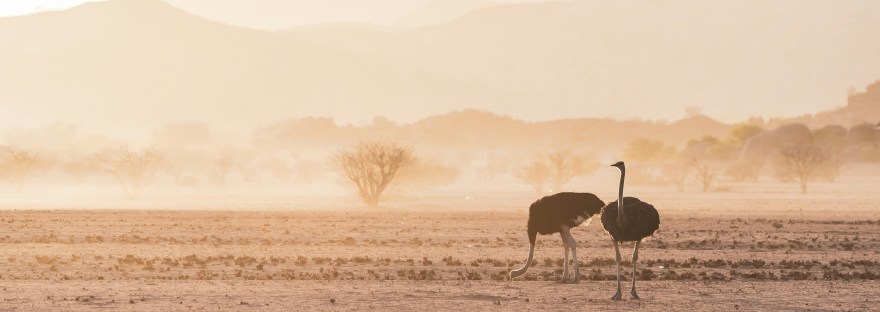
Chandler replicated that he had actually meant the desert ‘of Australia’, implying that the people had fed ostriches – a species I apparently associate with Australia. The interlocutor protested, saying that this didn’t count because ostriches aren’t birds (probably again in my Western mindset).

At that point, I woke up. What the hell was that all about?! And why Chandler? I haven’t watched an episode of Friends for like 30 years…Then I started ruminating on the word ‘ostrich’. I confess that I couldn’t remember the English word: my mind kept going back to the Italian, struzzo. Maybe I got my wires crossed because of the striking similarity between ‘ostrich’ and ostrica, the Italian word for oyster? Anyway, all this kept me awake for a while, and when I couldn’t resist any longer, I went to check my phone. Here’s what I learnt:

  1. Struzzo (but also ‘ostrich’, with Anglo-Norman and Old French influences) comes from the Latin Struthio camelus, which in turn is derived from two Greek words meaning ‘camel-like sparrow’. So it is a bird after all!
  2. Ostriches are originally from Africa, not Australia.
  3. Ostriches are known for not being able to fly, but they are fast runners and can kick predators hard if they feel threatened. Most interestingly for me, sticking their heads in the sand is a legend!

On a side note, while I was researching ostriches on the internet, a question in the People Also Ask box caught my attention: whether Muslims can eat ostriches. What kind of question is that?!

So there I was at 4am, studying the etymology of an ancient bird species, all because of a weird dream I’d had. If that doesn’t qualify me as a language nerd, I don’t know what does!

PS If you have any suggestions on how to interpret this dream, I’m all ears. Not to be polemic, but personally I can’t help seeing some analogy with the situation in Gaza, where people are dying of starvation in the desert while the Western world sticks its head in the sand – even though I now know that ostriches don’t actually do that, but try telling my Western mindset that!
academic journals, academic publishing, academic writing, publishing, translating

Another year, another Yearbook. The Italia Contemporanea Yearbook 2021 is out!

Last year, I was invited to translate the very first edition of the Italia Contemporanea Yearbook 2020, a selection of historical articles originally published in Italian in the journal Italia Contemporanea. It appears the editors were happy with my work, because they asked me to translate the second edition, which has just been published.

The new Yearbook covers a very broad range of topics as well as different historiographical and methodological approaches. More importantly, it presents original research that exceeds national boundaries, highlighting connections and interactions with Germany, Libya, Algeria and the Unites States. As such, it manages to overcome a common problem for editors of similar journals, as the editors explain in their introduction, namely that of reconciling “national, regional and local scales, offering a dynamic overview capable of locating themes and issues in the most appropriate contexts and restoring their interconnections — or even their deviations and specificities — in comparison to the global framework”.

As previously, all articles are freely available, which greatly contributes to the international exchange among scholars working on Italian history. Again, I am very proud to have been part of this project and hope that the publisher, FrancoAngeli, will continue to finance it.

You can access the TOC and download the Yearbook 2021 at this link

academic journals, academic publishing, academic writing, publishing, translating

The Yearbook. Translating Italian contemporary history for ‘Italia Contemporanea’

Although proofreading is my main activity, I am occasionally asked to do Italian to English translations. Exactly one year ago, I was approached by the editor of one of Italy’s main history journals, Italia Contemporanea, with a request to translate 10 recently published articles for a completely new, English-language ‘Yearbook’.

The publication of the Yearbook vaguely coincides with the 70th anniversary of the institute that had launched the journal in 1949, the ‘Istituto nazionale per la storia del Movimento di Liberazione in Italia’ (National Institute for the history of the Liberation Movement in Italy). But the reason behind the decision to launch an English-language ‘Yearbook’ was another: whereas many libraries across Europe are subscribed to Italia contemporanea, historians who aren’t Italian native speakers don’t necessarily read Italian. It was therefore time to offer a new series of publications aimed specifically at an English-language audience.

To be fair, Italian scholars also tend to struggle with research published in other languages. I recall having to persuade an Italian contributor to a special issue (for a British journal) that I co-edited some years ago to at least mention a few relevant English-language publications, as the journal’s editor-in-chief had suggested. This absence was mainly due to the fact that the author didn’t read any English at all.

This is why I think both English-language and Italian-language journals should start offering selected translations, making them available in open access. Only thus, research outputs that would otherwise remain restricted to a specific audience will truly become available to a global readership. For now, Italia contemporanea has taken a first step in this direction, and I am extremely proud to have contributed to this endeavour – by no means an easy one, given the broad range of topics and the varying writing styles I was faced with.

I also strongly recommend anyone interested in Italian contemporary history to have a look at the Yearbook. It offers a very broad and versatile range of articles, from women’s political participation after WWI in the bordering cities of Fiume and Sušak to a gender-focused analysis of welfare history in Italy; from museum representations of the colonial past to the Italian ‘communist question’ in American foreign politics; from recent Italian historiography on 1968 to the relationship between deindustrialisation and industrial heritage in Italy.

And my favourite: the primary role (and struggles) of women translators in the translation industry between the two world wars. It’s amazing to see how certain things (like keeping translators on a financial leash) haven’t changed…

You can access the TOC and download the Yearbook at this link